v0.12.0 | Clockwork
HalfEngine 0.12.0 is here, finalizing the core architecture phase. This update introduces a reactive event-driven backend, robust clock synchronization, reliable command channels, enhanced debugger, and more!
Features
Reactive Backend
The Host has been refactored into an event-driven architecture. Instead of dispatching Commands immediately upon receipt, the Host now queues them during the tick cycle, sorts them deterministically, and dispatches them in order to their respective handlers. This has a few benefits:
- Handlers are dispatched in a predictable order, ensuring that given the same inputs, the end result will always be the same
- Saves processing time. The Host does not need to keep polling each subsystem every tick. Instead, a subsystem is only triggered if an event it is interested in is received
- Subsystems are fully self-contained and decoupled from the Host’s main loop. Changing a subsystem will not have any effect on surrounding, unrelated subsystems; making the system as a whole easier to maintain and reason about
The work done here also revealed an “emergent feature” that was not planned initially. Because the Subsystems are designed as stateless logic processors (they do not maintain internal simulation state), they can be offloaded into shared objects (DLL/SO binaries) and loaded at runtime; enabling a runtime, with potential hot-reloading capability, plugin system! However, this feature is not required now and will not be implemented because there is more important work that needs to be done.
Clock Synchronization
A clock synchronization and prediction system has been implemented. The Client does an NTP-style handshake to estimate the Host’s clock offset and RTT. This enables the Client to map its own local clock to the Host’s clock, which simplifies the implementation of many systems including server-side lag compensation.
Command Transport Reliability
Commands are now split into reliable and unreliable channels. Reliable commands are critical commands that must be delivered (such as a Login command) and will be retransmitted when they fail to go through (TCP-style reliability). Unreliable commands are non-critical commands that can be lost without causing problems, like movement, which is sent frequently and subsequent commands will correct the state even if a previous command was lost.
This improves network throughput and client responsiveness. A failed Move command will not block other commands while its being retransmitted (Head-of-Line blocking).
Network Monitoring and Simulation Tools
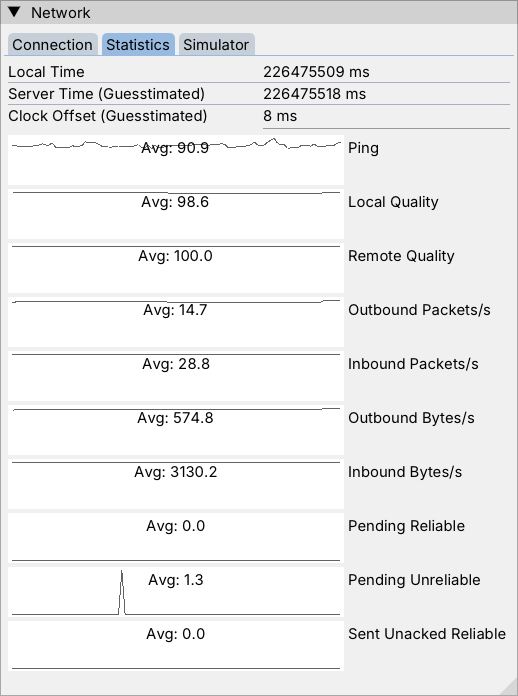
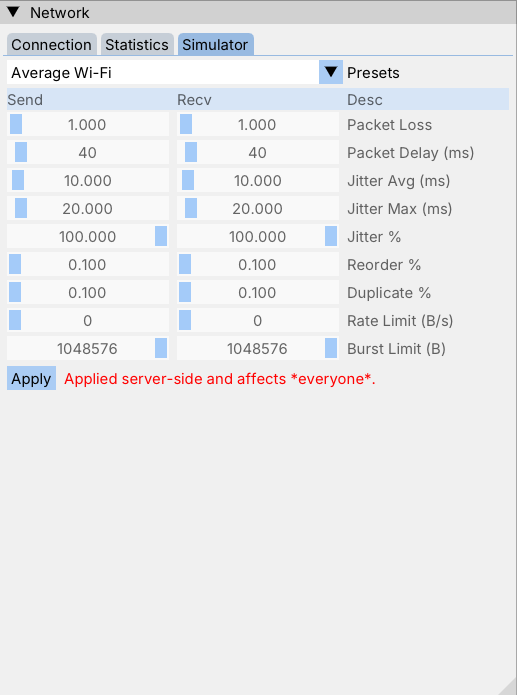
The debugger has been upgraded with additional tools to monitor and simulate network conditions.
The Statistics window displays the network statistics in graphs that show the current and historical parameters, along with a moving average of the respective paramter.
The Simulator window allows the user to apply network parameters server-side to simulate various network conditions for testing.
Fixes and Improvements
- Fix Agent movement not scaling with the timestep. Scaled time now affects Agent movement speed
- The RNG is now initialized with a high-entropy seed from a cryptographically secure random source, making its output sequence less predictable for a given Run.
- The Client and Debugger codepaths have been unified server-side. There is now a single pipeline that handles both of them, reducing code duplication
- Due to the refactor above, a potential future vulnerability surfaced and was fixed: Commands have flags/attributes, and those flags used to be set by the client. This would allow a client to run commands that might require elevated privilages, due to both privilaged and normal commands being consumed through the same pipeline. The flags from incoming commands are no longer considered server-side. Instead, the server checks the flags internally, and unauthorized commands are dropped
- Various data layout and allocation pattern optimizations
- Improved error handling and logs output
What’s Next?
The next phase of development will move away from engine plumbing and into the content and production phase. The work will now focus on getting external content into the simulation, starting with static geometry, and later moving to dynamic and interactable elements. From now on, the core engine will only receive updates as required by gameplay systems, not in isolation.
If this sounds interesting to you, consider following the project to get notified of future updates!
You can download and test v0.12.0 below. If you encounter issues, please start a new discussion.
Cover image provided by Holedulidu on Pixabay.
Leave a comment
Log in with itch.io to leave a comment.